


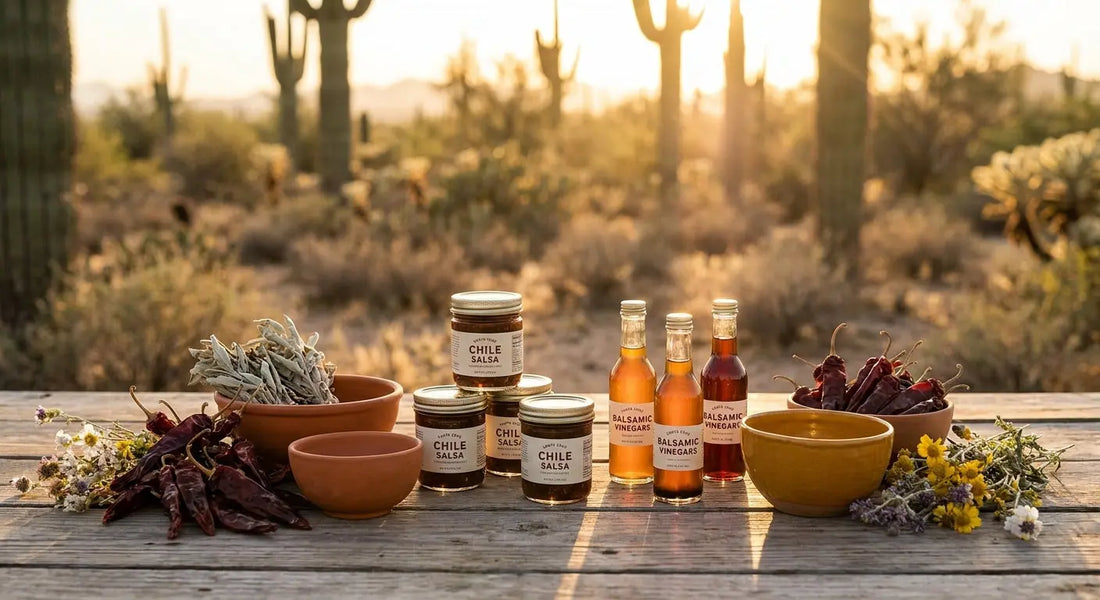
A Story 274 Years in the Making
In 1752, Spanish colonial soldiers established a presidio along the Santa Cruz River Valley, founding what we now call Tubac, Arizona. It became one of the oldest continuously inhabited settlements in the American Southwest, a place where O'odham Native traditions, northern Mexican Sonoran cooking, and Spanish colonial foodways collided, merged, and evolved over centuries.
Sitting just 40 miles south of Tucson and 17 miles north of Nogales, Tubac is a true borderlands crossroads. The flavors born here are not invented; they are inherited. Every jar of artisan condiment made in this desert town carries that 274-year story forward. Provenance is not a marketing word here. It is the most important ingredient we have.
The Land That Flavors Everything
Southern Arizona grows ingredients you simply cannot find anywhere else: chiltepins, the tiny wild chiles that have thrived in canyon shade for millennia; Santa Cruz chiles, cultivated specifically in the Santa Cruz River Valley south of Tubac, with a fruity warmth that no generic "Southwestern" pepper can replicate; prickly pear fruit, desert honey, mesquite flour, cholla buds. These are not trendy additions to a label. They are the backbone of a food culture that stretches back thousands of years.
On December 15, 2015, Tucson became the first city in the United States to earn a UNESCO Creative City of Gastronomy designation. That recognition honored a culinary heritage spanning over 4,000 years, rooted in exactly these indigenous Sonoran Desert ingredients. The designation did not create something new; it acknowledged what Southern Arizona farmers, foragers, and cooks have always known.
Think of it as desert terroir. The high-desert climate, alkaline soils, and seasonal monsoon rains shape the heat, sweetness, and complexity of local chiles and botanicals in ways no other region on earth can reproduce. A Santa Cruz chile grown in this valley tastes different from a chile grown 200 miles north, just as a Burgundy grape tastes different from one grown in California. Mass-market brands slap a "Southwestern" label on products made with commodity ingredients from anywhere. Our ingredients have names, places, and histories.
Inside the Small-Batch Process: What 'Handcrafted' Actually Means
The word "handcrafted" gets thrown around loosely, so let us be specific about what it means in our kitchen.
It starts with sourcing whole, all-natural ingredients: no dehydrated powders reconstituted with water, no flavor concentrates. Whole chiles, whole garlic, whole onions, whole fruit. From there, chiles and aromatics are roasted by hand, often in small batches over open flame, until the skins blister and the sugars begin to caramelize. Then comes hand-peeling, a slow and labor-intensive step that preserves the flesh and flavor compounds that mechanical processing strips away.
At every stage of cooking, we taste. Not once, not twice, but continuously. Small-batch production means every run is monitored and adjusted by palate and texture rather than by automated sensors and pre-programmed timers. A mass producer operating at industrial scale physically cannot do this. Their consistency comes from formula. Ours comes from attention.
When the product is ready, it goes into jars and bottles labeled by hand. This is not a stylistic choice. It is a physical signal that human hands touched every step, from field to finished product. You can feel the difference when you pick up the jar, and you can taste it when you open it.
The result is a clean label: no artificial preservatives, no fillers, short ingredient lists where you recognize every word. About 61% of consumers now say they are shifting toward products that feel "real" and transparent. We did not pivot to meet that trend. We have always been here.
Artisanal small-batch condiment bottles typically retail at $20 or more, compared to roughly $5 for mass-market equivalents. That 4x price premium is not about fancy packaging. It is earned through process: the sourcing, the roasting, the hand-peeling, the tasting, the care. You are paying for what is actually in the jar and the people who put it there.
Tubac's Artisan Culture: Where Craft and Culinary Tradition Intersect
Tubac is not a typical small town. It is home to over 100 world-class galleries and eclectic shops, with no chain restaurants in sight. The annual Tubac Festival of the Arts has been running since 1959, making it Southern Arizona's longest-running art festival, ranked #1 in Arizona and #10 nationally by Sunshine Artists. Fine art, handcrafted goods, artisan food, and live entertainment all share the same dusty, sun-warmed streets.
This arts-forward, craft-obsessed community ethos directly shapes the food culture. In a town where handmade is the baseline expectation, mass-produced shortcuts feel out of place. The same impulse that drives a Tubac potter to shape clay by hand drives us to roast chiles over flame and label jars one at a time.
This matters more than ever. "Story-led consumption" has emerged as a defining food trend of 2026, with consumer conversations about authenticity growing 31% year-over-year. People want to know who made their food, where, and why. A 2025 survey of over 21,000 consumers across 28 countries found that buyers are twice as likely to choose local products over non-local ones. "Made in Tubac, Arizona" is not a vague origin claim. It is a provenance statement with genuine geographic and cultural weight.
For food lovers and gift shoppers looking to bring this artisan community's craft to their own table, our curated gift sets (available in 2-bottle, 4-bottle, and 6-bottle configurations) offer a direct way to experience what Tubac tastes like. Consider them a discovery kit from a desert town where craft is simply how things are done.
Why Southern Arizona Condiments Belong in Every Kitchen
These are not regional novelties meant to sit on a shelf as souvenirs. Southern Arizona artisan condiments have genuine culinary range. Balsamic vinegars reimagined through a Southwest lens work as BBQ glazes, cheese board companions, and finishing drizzles over grilled meats. Chile-forward salsas and hot sauces deliver layered heat that builds flavor rather than just burning. The sweet-savory combinations surging in popularity right now (think aged balsamic over stone fruit, or chile-infused vinegar on roasted vegetables) are exactly what we have been making for years.
The broader market reflects this momentum. The specialty food market was valued at $260 billion in 2025 and is growing at an 8% annual rate. Consumer appetite for premium, story-driven food is not a niche. It is the direction the entire market is moving.
So the next time you reach for a condiment, you have a choice: grab something generic off the shelf, or choose something with a 274-year story behind it, made by hand in a desert town where craft is a way of life. Open the jar. Taste the difference that story makes.