


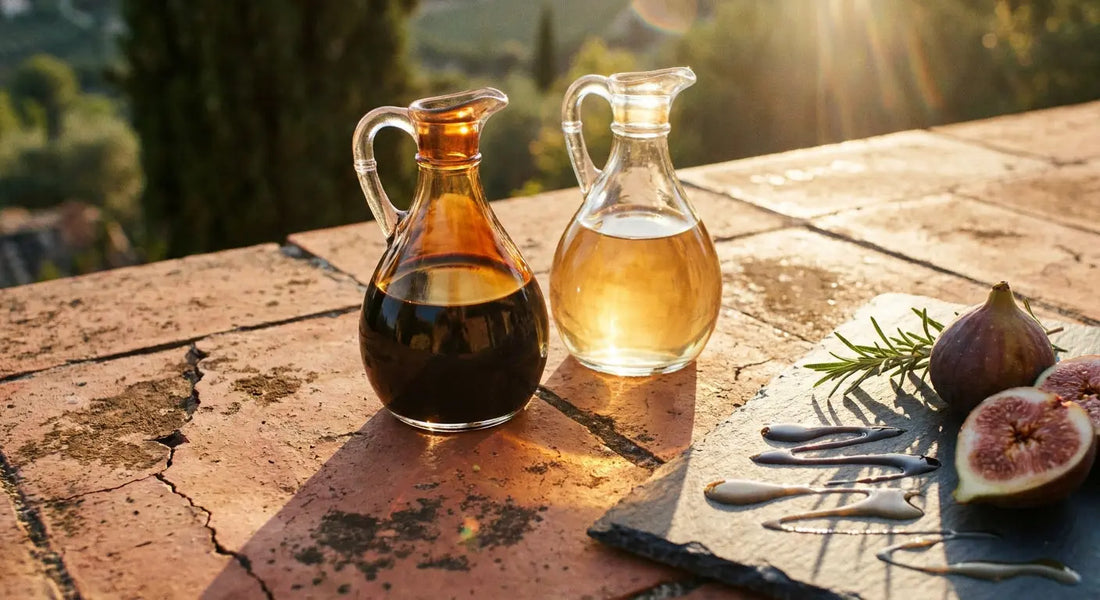
Two collections, one ancient craft, and a whole world of flavor between them. Our Aged Dark Balsamic Vinegar Modena and Aged White Balsamic Vinegar Modena collections both trace their roots to the storied vineyards of Modena, Italy, yet they arrive at your table with very different personalities. If you've ever stood in front of our shelves (or scrolled through our site) wondering which direction to go, this guide will help you pick the right bottle, or bottles, for the way you actually cook.
At a Glance
| Dimension | Aged Dark Balsamic Vinegar Modena | Aged White Balsamic Vinegar Modena |
|---|---|---|
| Base Grape | Trebbiano & Lambrusco must, cooked at high heat | White Trebbiano must, cooked at low temperature under pressure |
| Color | Deep mahogany to near-black | Pale gold to light amber |
| Flavor Profile | Bold: caramel, dried fruit, molasses, fig, oak | Bright: floral, tart, fruity, clean finish |
| Aging | Traditional Solera Method in multiple wood barrels (oak, chestnut, cherry, and more) | Aged in new, unfired wood barrels; typically shorter aging to preserve color |
| Best Uses | Finishing steaks, roasted vegetables, reductions, cheese boards, desserts | Vinaigrettes, seafood, fruit salads, light sauces, dishes where color matters |
| Flavor Variety | Wide range (e.g., Acai Berry, Apricot, Banana Caramel Pecan, Bergamot Lemon, Black Currant) | Wide range (e.g., Acai Berry, Apple Cinnamon, Apricot Plum, Blueberry) |
| Visual Impact on Dishes | Adds a dramatic dark drizzle | Keeps dishes looking bright and fresh |
| Shelf Stability of Color | Color stays consistent over time | Naturally oxidizes and darkens; best used within a few months for color-critical dishes |
How They're Made: The Same Tradition, Two Different Paths
Both collections start with grapes grown in the Modena region, and both honor centuries of Italian vinegar-making craft. The fork in the road comes down to heat. Dark balsamic must is cooked at high temperatures in copper kettles over an open wood fire, allowing the natural sugars to caramelize. That caramelization is what gives dark balsamic its signature mahogany color and its layered sweetness. The must then moves through a progression of successively smaller barrels, each made from a different wood (oak, chestnut, acacia, cherry, mulberry, ash, juniper), following the traditional Solera Method.
White balsamic takes a gentler approach. The must is cooked at lower temperatures under pressure, which prevents caramelization entirely. The result is a vinegar that keeps the grape's natural floral and tart characteristics intact. It ages in new, unfired wood barrels, typically for a shorter period, to preserve that pale golden hue. It's not a lesser product; it's a masterpiece of temperature control that captures flavors high-heat cooking would otherwise destroy.
Flavor: Bold Depth vs. Bright Lift
This is where the two collections really part ways. Our dark balsamics deliver rich, complex notes: think caramel, dried fig, molasses, and toasted oak, all rounded out by whichever fruit or flavor infusion we've added. A drizzle of Banana Caramel Pecan dark balsamic over vanilla ice cream, for instance, is the kind of thing that makes people close their eyes and ask what you just put on there.
Our white balsamics, on the other hand, lead with brightness. They're tart, clean, and fruity, with a lighter sweetness that doesn't overpower delicate ingredients. An Apple Cinnamon white balsamic tossed with arugula and shaved Manchego keeps every element distinct rather than blanketing the plate in sweetness. If dark balsamic is a slow desert sunset, white balsamic is the clear morning light that follows.
Culinary Versatility
Dark balsamic is the classic finisher. It shines on grilled meats, roasted root vegetables, aged cheeses, and rich desserts. Reduce it into a glaze and you have a sauce that belongs on everything from a Sonoran-style carne asada to a simple caprese. Its bold color also makes it a natural choice when you want that dramatic drizzle across a white plate.
White balsamic earns its place wherever you need acidity without visual weight. It's ideal for vinaigrettes, ceviche, light pasta dishes, fruit salads, and pan sauces for fish or chicken. Because it won't stain a cream-colored risotto or turn a peach salad brown, it's the go-to for dishes where presentation is part of the pleasure. It also plays beautifully in cocktails and mocktails; the 2026 Summer Fancy Food Show in New York featured balsamic-infused drinks as a growing trend, and our fruit-forward white balsamics are tailor-made for that kind of experimentation.
Flavor Variety Across Each Collection
Both collections offer a wide, adventurous range of infusions. The dark balsamic lineup includes fruit-forward options like Acai Berry and Apricot alongside more indulgent profiles like Banana Caramel Pecan. The white balsamic collection mirrors that spirit of exploration with flavors like Blueberry, Apricot Plum, and Apple Cinnamon. In both cases, we handcraft these in small batches right here in Tubac, Arizona, using all-natural, premium ingredients with no artificial preservatives or fillers. Every bottle is hand-labeled, because that's what artisan production actually looks like.
Neither collection is "bigger" or "better" in terms of variety. Both give you plenty of room to play, pair, and discover new favorites.
Health Benefits
Good news on both sides: balsamic vinegar is low in calories (roughly 14 per tablespoon), fat-free, and rich in acetic acid and polyphenols. Research published in the journal Antioxidants found that Balsamic Vinegar of Modena had the highest antioxidant value among 23 vinegars tested. A 2024 study in the Journal of Functional Foods reported that consuming one to two tablespoons of balsamic vinegar before a high-carb meal reduced post-meal blood glucose spikes by up to 20%. These benefits apply to both dark and white balsamic, so health alone isn't a deciding factor between the two collections.
Shelf Life and Storage
Dark balsamic is remarkably stable. Its deep color doesn't shift noticeably over time, and it can sit in your pantry for years without losing character. White balsamic is a bit more temperamental visually; natural oxidation will gradually darken it from gold to deep amber. The flavor stays intact, but if you're using it specifically because you want that pale, clean look on a dish, plan to use it within a few months of opening for the best visual results.
The Verdict: Which Collection Should You Buy?
If you love bold, rich finishing flavors and you cook a lot of grilled meats, roasted vegetables, or desserts, our Aged Dark Balsamic Vinegar Modena collection is the place to start. It's the more traditional of the two, and its depth of flavor makes it the most versatile all-around pantry staple for most home cooks and grill masters. For someone buying their first flavored balsamic, dark is the foundation we'd recommend building on.
If you cook a lot of seafood, salads, and lighter fare, or you care deeply about keeping dishes looking bright and clean, our Aged White Balsamic Vinegar Modena collection will earn a permanent spot next to your stove. It's also the better pick for anyone experimenting with balsamic in drinks or wanting a crisp, tart counterpoint to fruit-based dishes.
If you can't decide? Honestly, the best answer is both. They complement each other rather than compete. A dark balsamic reduction on steak paired with a white balsamic vinaigrette on the side salad is the kind of one-two punch that turns a Tuesday dinner into something worth remembering. Check out our curated gift sets if you want to explore both collections in a single order.