


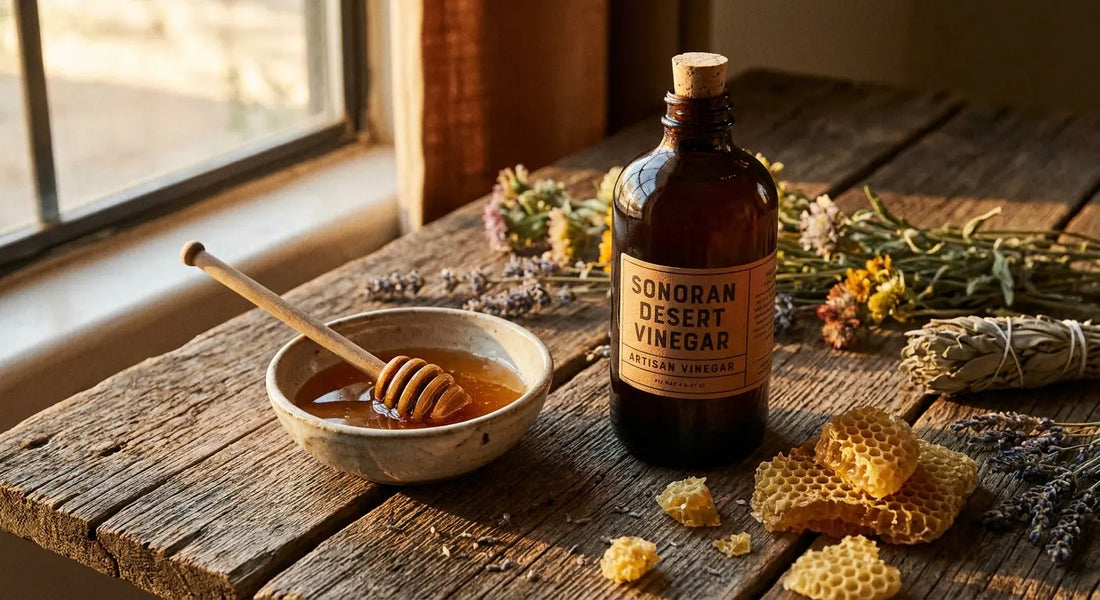
The Secret Bottle Chefs Are Quietly Reaching For
Most pantries hold five or six forgettable vinegars. A dusty white wine vinegar behind the oil. A half-used bottle of rice vinegar from a stir-fry two years ago. Barrel-aged honey vinegar is the one bottle that can replace them all, and chefs across the country are starting to say so out loud.
Bartenders at upscale venues have named vinegar as the next cocktail frontier for 2026, and premium specialty condiment segments are growing at 6 to 10 percent per year, far outpacing the broader condiments market. Something is shifting.
What follows is a walk through what barrel-aged honey vinegar actually is, why it tastes unlike anything else on the shelf, how to use it from the grill to the cocktail glass, and why this ingredient is having a genuine cultural moment. It is a story about craft, patience, and ingredients that carry a sense of place, told from the heart of the Sonoran Desert.
What Is Barrel-Aged Honey Vinegar, and Why Is It Different?
The process starts with mead, the ancient honey wine. Slow-fermented mead is transferred into American oak barrels and left to age, a tradition traceable to at least 1823. After the barrel has done its work, raw honey is added as a finishing touch, locking in a floral honey signature with a balanced tang you simply cannot find in commercial vinegars.
Quick-fermented vinegars, the kind that fill most grocery store shelves, skip all of this. They are produced in hours or days, not months. The result is a one-dimensional sharpness with none of the layered sweetness, gentle acidity, or wood-derived vanilla and caramel notes that barrel aging imparts.
The oak barrel itself is doing real work here. The wood absorbs and releases compounds over time, adding depth and complexity. If you already appreciate the character that barrel aging brings to craft bourbon or whiskey, you understand the principle: the same patience, the same transformation, applied to vinegar.
Barrel-aged honey vinegar is not a substitute for apple cider vinegar or balsamic. It occupies its own category entirely. The mead base gives it a honeyed warmth that apple cider vinegar cannot match, while the barrel aging adds a richness that balsamic approaches from a completely different direction. This vinegar deserves its own spot on the shelf.
The Flavor Profile: Sweet, Tangy, and Wildly Complex
The first thing you notice is the honey, floral and round, greeting you before any acidity arrives. Then the oak backbone shows up: warm, steady, carrying whispers of vanilla and caramel from the barrel's interior. The finish is clean and bright, a gentle tang that lifts the whole experience rather than overwhelming it.
The balance is the key. Because the base is mead rather than grain alcohol or fruit juice, and because raw honey is added after aging, the acidity is softened naturally. There is no harshness, no pucker. Compare that to the sharp bite of white vinegar or even the sometimes-aggressive tang of apple cider vinegar, and you will understand why chefs reach for this bottle first.
The 2026 "swicy" trend (sweet plus spicy) positions this vinegar perfectly. Its natural sweetness and acidity deliver that sought-after profile without any added sugar. Producers like American Vinegar Works have leaned into this convergence with offerings such as their Hot Honey Wine Vinegar, a barrel-aged mead vinegar spiked with four chilies. Whole Foods Market's 2026 trend predictions validated aged vinegar and honey flavor pairings as firmly mainstream. The moment is here.
How to Use It: From the Grill to the Cocktail Glass
As a specialty pantry staple that earns its keep across every meal, barrel-aged honey vinegar is hard to beat. Its versatility is genuinely remarkable.
In the kitchen: Use it to build salad dressings with real depth. Whisk it into marinades for grilled meats, where the honey and oak notes caramelize beautifully over flame. Deglaze a hot pan after searing pork chops or chicken thighs, and you will have an instant sauce with layers of flavor. Drizzle it over roasted root vegetables in the last minute of cooking, or spoon it over fresh summer fruit for a dessert that stops conversation.
Behind the bar: Bartenders in 2026 are moving away from simple sweet-sour profiles toward savory, acidic complexity, and barrel-aged honey vinegar is emerging as a hero ingredient. Drinking shrubs, those old-fashioned vinegar-based syrups, are back in a big way. Over 40 percent of Americans are actively cutting back on alcohol this year, and sophisticated vinegar-based shrubs and non-alcoholic aperitifs are filling that gap with real flavor.
Here is a quick direction to try at home: combine two tablespoons of barrel-aged honey vinegar with sparkling water, a squeeze of fresh grapefruit or lemon, and a sprig of rosemary or thyme. Stir, add ice, and you have an instant non-alcoholic aperitif with more character than most cocktails.
If you are already building a pantry of artisan vinegars, consider pairing barrel-aged honey vinegar alongside flavored balsamic vinegars for layered dressings and marinades. Combining a dark cherry balsamic with a splash of honey vinegar in a vinaigrette, for example, creates something neither bottle could achieve alone. That kind of pantry depth is what turns a good home cook into a confident one.
The Wellness Angle: A Functional Pantry Staple With Real Credentials
Barrel-aged honey vinegar delivers gourmet flavor and genuine wellness benefits, earning a place in what many are now calling the "functional pantry."
A 2023 systematic review published in the European Journal of Nutrition found that vinegar consumption improved markers of cardiovascular health, including modest reductions in total cholesterol and triglycerides. That is not folk wisdom; it is peer-reviewed science.
The gut-health story is equally compelling. Honey's oligosaccharides act as prebiotics, feeding beneficial Bifidobacterium and Lactobacillus species in the gut. Meanwhile, the acetic acid in vinegar stimulates digestive enzyme production, supporting the body's natural digestive process. Honey vinegar is also rich in enzymes, vitamins, minerals, and antioxidants, and it actively encourages the growth of beneficial bacteria.
To be clear, we are not making health claims here. The flavor is the primary reason to reach for this bottle. But for health-conscious food lovers, knowing that a drizzle of barrel-aged honey vinegar brings functional benefits alongside extraordinary taste is a genuine bonus. The market reflects this dual appeal: the honey vinegar market reached a valuation of $6.32 billion in 2026 and is projected to expand at a 14.1 percent CAGR through 2035. Consumers are paying attention.
Why Artisan and Small-Batch Matters Here
With barrel-aged honey vinegar, the production method is inseparable from the flavor. Slow fermentation and genuine barrel aging cannot be rushed or replicated at industrial scale. The patience is the point.
Home enthusiasts can experiment with the process themselves. A small 2-liter oak barrel ages vinegar approximately four times faster than a large commercial barrel, meaning a DIY batch can be ready in two to three months. But artisan producers have already done the hard work, dialing in the fermentation, selecting the right barrels, and finishing with the right honey at the right moment.
There is a terroir story here, too. Just as single-origin olive oils and varietal honeys carry a sense of place, barrel-aged honey vinegar made from regional mead reflects its origin. Arizona desert honey carries the wildflower character of the Sonoran landscape, a provenance story rooted in Southwest identity that mass production simply cannot replicate.
At Tubac Gourmet Foods, this is exactly the philosophy we live by. Handcrafted in small batches in Tubac, Arizona, honoring Sonoran Desert heritage, with hand-labeled bottles reflecting true artisan production. Every jar and bottle carries that sense of place. And for gifting, a bottle of barrel-aged honey vinegar paired with an artisan olive oil makes a premium, conversation-starting gift. Our curated gift sets, available in two-bottle, four-bottle, and six-bottle configurations, are built around exactly that kind of experience.
Time to Add It to Your Pantry
Barrel-aged honey vinegar is not a passing trend. It is an underrated classic finally getting the recognition it deserves from chefs, bartenders, and adventurous home cooks who refuse to settle for ordinary.
One bottle works in dressings, marinades, cocktails, shrubs, and finishing drizzles. It is a genuine pantry workhorse with a flavor story no other vinegar can match: floral honey, warm oak, a bright clean finish that lingers just long enough to make you reach for it again.
Explore the world of artisan vinegars and bold, Sonoran-inspired pantry staples. Start with one bottle. Let the honey and oak do the talking. Take a taste, and let the warmth of the desert find its way into your kitchen.